What bucking bar do 3/16 and 1/4 inch solid rivets need? For 3/16 inch rivets, plan on a bar of roughly 4 to 5 lb or more, and on something heavier for 1/4 inch. Pair it with a 3X or 4X rivet gun and, if you can, a second person on the bar. A 1/4 inch shank holds four times the metal of a 1/8 inch rivet, so the bar, the gun, and the way you work all have to scale up. The numbers below come from an Army airframe manual, the FAA, and two EAA authors. Where no source gives a number, we show the arithmetic.
What changes when the rivet gets bigger
The dash number gives the diameter in 32nds of an inch. A -6 rivet is 3/16 inch and a -8 is 1/4 inch, the same system used in our rivet size to bucking bar weight guide. Shank cross-section grows with the square of the diameter. EAA author Jack Dueck puts the force needed to set a -3 rivet at about 345 lb and a -4 rivet at about 615 lb, and those two figures follow the same square law. Carrying it up gives the last two rows below. They are our arithmetic, since Dueck did not publish them.
| Rivet | Diameter | Metal vs a -4 | Setting force | Shop head, width x minimum height |
|---|---|---|---|---|
| -4 | 1/8 inch | 1x | about 615 lb (Dueck) | 3/16 x 1/16 inch |
| -6 | 3/16 inch | 2.25x | about 1,400 lb | 9/32 x 3/32 inch |
| -8 | 1/4 inch | 4x | about 2,500 lb | 3/8 x 1/8 inch |
Two more rules from the EAA articles tighten as the rivet grows. The tail should stand about 1.5 diameters proud of the joint, which is 9/32 inch on a -6 and 3/8 inch on a -8, and Dueck notes that a longer tail tends to bend over instead of forming a head. Material distortion is also likely when the rivet diameter is more than 5.5 times the thinnest sheet in the joint. That means sheet thinner than about 0.034 inch for a 3/16 inch rivet and about 0.045 inch for a 1/4 inch rivet.
Alloy rules change above 3/16 inch
FAA AC 43.13-1B allows 2117 (AD) rivets to be driven as received. It says 2017 rivets above 3/16 inch and all 2024 (DD) rivets must stay packed in dry ice or refrigerated until driven, or be reheat treated just before driving, because they are otherwise too hard for satisfactory riveting. A 3/16 inch 2017 rivet can go in as received, and a 1/4 inch 2017 rivet cannot. For any rivet that comes out of the cold, set up the bar, the gun, and the rivet set first.
How heavy should a bucking bar for large rivets be?
An Army aviation training manual, Basic Airframe Repair, says a bucking bar for 1/8 inch rivets must weigh at least 2 pounds and that larger rivets need proportionately heavier bars. It adds that a light bar takes too many blows, and the blows tend to deform the rivet head. It does not say proportional to what, so the table scales the 2 lb figure two ways.
| Rivet | Scaled by diameter | Scaled by cross-section | Published figure |
|---|---|---|---|
| -4 (1/8 inch) | 2 lb | 2 lb | Army manual: at least 2 lb |
| -6 (3/16 inch) | 3 lb | 4.5 lb | EAA, Bingelis: at least 5 lb for spar rivets |
| -8 (1/4 inch) | 4 lb | 8 lb | None found |
Tony Bingelis, in an EAA article on RV spar assembly, writes that a heavy bar means one that weighs at least 5 pounds, and that none of the typical 2 to 3 pound bars will be heavy enough for 3/16 inch rivets. His 5 lb sits above both scaled figures for 3/16 inch, which points toward the upper part of the 4 to 8 lb range for 1/4 inch. Treat 8 lb as the top of that range. His advice was written for spar rivets that pass through several layers of aluminum. Our rivet size guide lists 3.5 to 4.5 lb as where tungsten users land at 3/16 inch, so read his 5 lb as the spar number.
Weight also decides how many blows the rivet takes. Bingelis says to form big shop heads in as few blows as possible, because many light blows flare the end of the rivet and work-harden it. Dueck’s guideline for AD rivets is to finish within two to three seconds, since the metal hardens as it is driven. Our guide to a bar that is too heavy or too light covers the signs to watch for.
Gun, squeezer, and a second pair of hands
Aircraft Spruce rates its economy 3X gun for rivets up to 3/16 inch (2,160 blows per minute, 2-7/8 inch stroke) and its 4X for rivets up to 1/4 inch (1,740 blows per minute, 3-1/16 inch stroke). Bingelis reports that some builders find a 3X a bit weak for 3/16 inch rivets, and he recommends a slow-hitting heavy-duty gun with good finger control. Our gun matching guide covers air pressure and setup.
Dueck calls setting rivets with a gun a two-person operation, one on the gun and one on the bar. Bingelis recommends having somebody else handle the heavy bar so you can use both hands on the gun and press it hard enough to keep it from bouncing and leaving a smiley. If you are working alone, see our solo riveting guide. Where a squeezer reaches, Dueck ranks a pneumatic squeezer first for control and the rivet gun last. Bingelis puts the capacity needed for 3/16 inch rivets at about 6,000 lb and warns that squeezers with longer reach handle smaller rivets. The bar is for the joints a squeezer cannot reach.
Large rivets are also hard to remove. Bingelis says a rivet of 3/16 inch or larger that goes through several layers expands until it looks fused in the hole, and that drilling one out risks enlarging the hole.
Why a tungsten bar at 4 to 6 lb
Bucking mass is the same in any metal, so a 5 lb steel bar and a 5 lb tungsten bar do the same work. Only the size differs. At 2.2 to 2.4 times the density of steel, the tungsten heavy alloy that keeps a big bar compact puts a given weight in under half the volume. Steel at about 0.284 lb per cubic inch takes roughly 20 cubic inches to reach 5.65 lb. ETBB05 reaches 5.65 lb in 9 cubic inches, at 4 by 1.5 by 1.5 inches. Confined structure limits how large a bar you can bring in, so the smaller block helps most there. Builders in the forum threads behind our bucking bar count guide prefer larger steel bars for open work, and a heavy steel bar does the job where there is room for it. Our tungsten versus steel comparison shows the math.
Heavy bars for 3/16 and 1/4 inch rivets
| Bar | Shape | Weight | Size (inches) | Access |
|---|---|---|---|---|
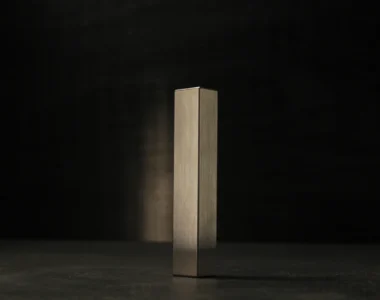
| ETBB46 | Straight | 4.2 lb | 6 x 1.1 x 1 | Open |
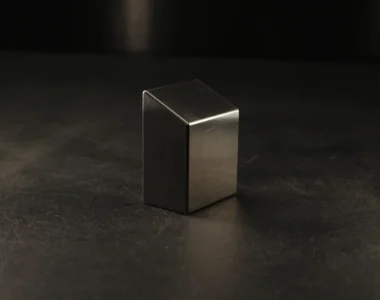
| ETBB47 | Offset | 5.05 lb | 5 x 2 x 2 | Open |
| ETBB05 | Straight | 5.65 lb | 4 x 1.5 x 1.5 | Open |
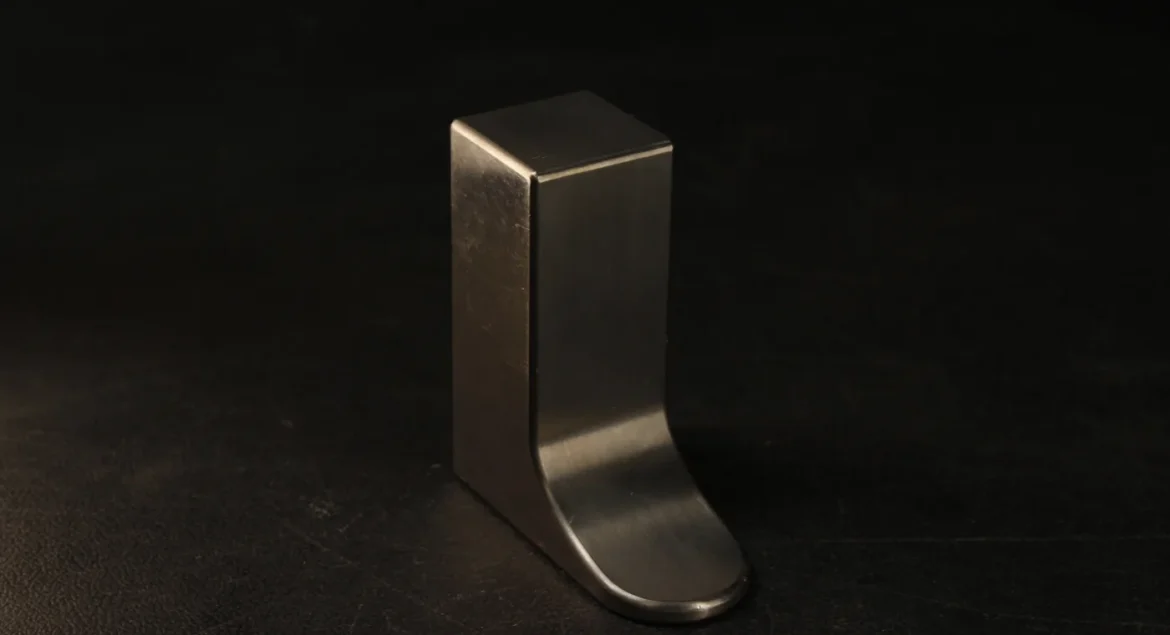
| ETBB37 | Hook | 5.75 lb | 5 x 1.5 x 1.5 | Edges and flanges |
| ETBB08 | Offset | 6.0 lb | 6 x 1.5 x 1.5 | Open |
ETBB46 at 4.2 lb sits inside the 3.5 to 4.5 lb range in our size guide for 3/16 inch rivets. ETBB05 reaches the 5 lb floor Bingelis gives for spar rivets in a compact straight block. ETBB08 is in the extra-heavy class, which starts at 6 lb. ETBB37 is the hook bar listed for edges and flanges, and ETBB47 is an offset bar for open structure. Every bar of 3 lb and up is on the heavy bucking bars page, and the bar selector filters by rivet size and access. If a 1/4 inch job needs a weight or shape outside the line, send a drawing, a sample, or the weight you need through our custom bar program.
Order ahead of the job. Most standard bars ship from stock, but if a bar is not in stock the standard lead time is 10 to 12 weeks, and there is no cart or list price, so you request a quote and the reply confirms pricing and availability.
Common questions
What bucking bar do I need for 3/16 inch rivets?
Roughly 4 to 5 lb or more. Our size guide puts tungsten users at 3.5 to 4.5 lb, and EAA author Tony Bingelis wrote that spar rivets this size need a bar of at least 5 lb and that 2 to 3 lb bars are too light.
What bucking bar do I need for 1/4 inch rivets?
No published weight turned up in our research. Scaling the Army manual’s 2 lb for 1/8 inch rivets gives 4 lb by diameter and 8 lb by cross-section, and Bingelis’s 5 lb at 3/16 inch points to the upper part of that range. Our heavy class starts at 3 lb and our extra-heavy class at 6 lb, and we make bars to drawing for weights outside the line.
What rivet gun do I need for 3/16 and 1/4 inch rivets?
Aircraft Spruce rates its economy 3X gun for rivets up to 3/16 inch and its 4X for rivets up to 1/4 inch. Bingelis reports that some builders find a 3X a bit weak at 3/16 inch, and he recommends a slow-hitting heavy-duty gun with good finger control.
Can one person buck 3/16 inch rivets?
EAA author Jack Dueck calls setting rivets with a gun a two-person operation, and Bingelis recommends a helper on the heavy bar. Where a squeezer reaches the joint, Dueck ranks a pneumatic squeezer first for control.
Do 3/16 and 1/4 inch rivets need to be chilled or heated?
It depends on the alloy. FAA AC 43.13-1B lets 2117 (AD) rivets be driven as received. It requires 2017 rivets above 3/16 inch, and all 2024 (DD) rivets, to be refrigerated or kept in dry ice until driven, or reheat treated just before driving.
How far should a 3/16 or 1/4 inch rivet stick out before driving?
About 1.5 diameters, which is 9/32 inch for a 3/16 inch rivet and 3/8 inch for a 1/4 inch rivet. A set rivet should have a shop head 1.5 diameters wide and at least 0.5 diameters tall.
Is a tungsten bar better than steel for large rivets?
At the same weight the two do the same work. Tungsten fits that weight into under half the volume, which helps in confined structure. Forum builders quoted in our bucking bar count guide prefer larger steel bars for open work.